Cloud vs Local AI: The Real Cost Comparison for Small Businesses
The real cost comparison of cloud vs local AI for small businesses: compute costs, data privacy, latency, and which model fits your workload.
Cloud vs Local AI: The Real Cost Comparison for Small Businesses
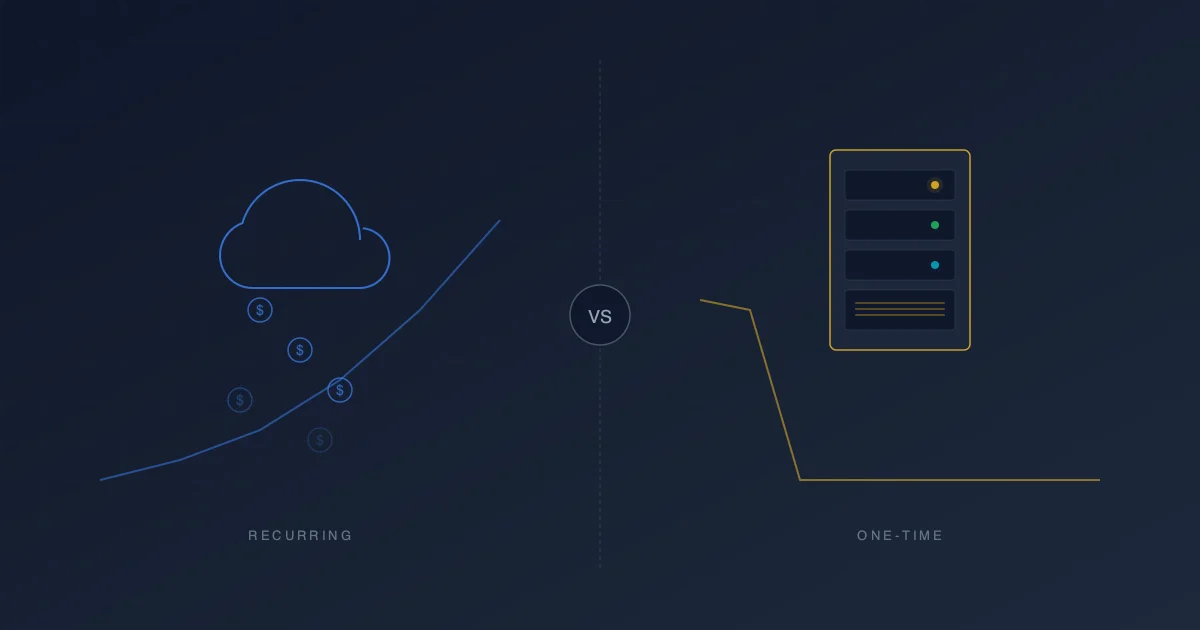
Everyone says local AI is "cheaper than cloud." But cheaper how? Over what timeline? For what team size? Here are the actual numbers, with real costs, so you can make this decision with your eyes open.
▸ The Cost Question Nobody Answers Honestly
If you've been researching AI for your business, you've seen the claims. Cloud advocates say "no upfront cost, pay as you go." Local AI advocates say "it pays for itself." Both are true. Both are misleading.
The honest answer is: it depends on your team size, how heavily you use AI, how long you plan to use it, and whether you have compliance requirements that add hidden costs to the cloud option.
I'm going to lay out the real numbers for three scenarios. Not theoretical projections. Actual costs based on current pricing and hardware specs in early 2026. You'll be able to plug in your own numbers and see where the break-even point falls for your company.
▸ The Three Options Most Businesses Are Comparing
Before we get to costs, let's define what we're actually comparing. Most mid-size businesses are weighing three realistic options:
Option A: Cloud AI Subscriptions ChatGPT Team, ChatGPT Enterprise, Microsoft Copilot, or Google Gemini for Business. Per-user monthly fees. Data processed on the vendor's servers.
Option B: Cloud API Access Using OpenAI, Anthropic, or Google APIs directly, often through custom applications. Pay per token (per word, essentially). Data still processed externally.
Option C: Local AI Deployment Open-source models running on your own hardware. One-time hardware investment plus minimal ongoing costs. Data never leaves your network.
Most business leaders are comparing Option A vs Option C. That's where we'll focus, with API costs as a reference point.
▸ Scenario 1: The 25-Person Company
A regional accounting firm. 25 employees. Uses AI for document summarization, client communication drafting, and internal Q&A.
Cloud Route: ChatGPT Team
| Item | Monthly | Annual |
|---|---|---|
| ChatGPT Team (25 users × $30/mo) | $750 | $9,000 |
| Microsoft Copilot add-on (10 power users × $30/mo) | $300 | $3,600 |
| Total | $1,050 | $12,600 |
3-year total: $37,800
Local Route
| Item | Cost | Type |
|---|---|---|
| GPU server (starter tier, single RTX 4090) | $6,000 | One-time |
| Setup (self-managed with IT team, using guides) | $0-$2,000 | One-time |
| Consulting (optional, for proper setup) | $3,000-$5,000 | One-time |
| Electricity (~200W average draw) | $350/year | Annual |
| Maintenance and updates | $500/year | Annual |
| Year 1 total | $9,850-$13,850 | |
| Year 2+ annual | $850 |
3-year total: $11,550-$15,550
The Verdict for 25 Users
Local saves $22,000-$26,000 over three years. The break-even point is around month 10-14 depending on whether you use a consultant for setup.
But here's the nuance: a 25-person firm with no compliance requirements and light AI usage might reasonably choose the simplicity of ChatGPT Team. The savings are real but moderate. The decision should hinge on whether you handle sensitive data (client financials, tax records). If you do, the privacy benefit tips the scale decisively toward local.
▸ Scenario 2: The 75-Person Company
A mid-size law firm. 75 employees. Heavy AI usage across the firm: contract review, legal research summaries, document drafting, client communication.
Cloud Route: ChatGPT Enterprise
| Item | Monthly | Annual |
|---|---|---|
| ChatGPT Enterprise (75 users × $60/mo) | $4,500 | $54,000 |
| Additional compliance review (annual) | — | $5,000 |
| Vendor risk assessment (annual) | — | $3,000 |
| Total | $62,000 |
Why the compliance costs? Because a law firm using cloud AI needs to document how client data is protected, review the vendor's SOC 2 reports, update their privacy policies, and potentially notify clients. These aren't optional for regulated firms. They're part of the real cost.
Local Route
| Item | Cost | Type |
|---|---|---|
| GPU server (professional tier, dual GPU) | $15,000 | One-time |
| Consulting engagement (full deployment) | $10,000 | One-time |
| RAG pipeline setup (document indexing) | Included above | — |
| Electricity | $1,500/year | Annual |
| Maintenance and support | $2,000/year | Annual |
| Year 1 total | $28,500 | |
| Year 2+ annual | $3,500 |
3-year total: $35,500
The Verdict for 75 Users
Local saves $150,500 over three years compared to cloud with compliance costs. The break-even point is around month 6.
And this doesn't account for the compliance simplification. With local AI, the firm's data handling story is clean: "AI runs on our servers. Client data never leaves our network." No vendor risk assessments. No updating privacy policies for third-party AI processors. No uncomfortable conversations with clients about where their confidential data went.
▸ Scenario 3: The 200-Person Company
A regional healthcare network. 200 employees across three locations. AI used for clinical note summarization, patient communication, administrative workflows, and internal knowledge management.
Cloud Route: Enterprise AI Suite
| Item | Monthly | Annual |
|---|---|---|
| ChatGPT Enterprise (200 users × $60/mo) | $12,000 | $144,000 |
| HIPAA compliance documentation and legal review | — | $15,000 |
| BAA negotiation and management | — | $5,000 |
| Annual vendor security audit | — | $8,000 |
| Cyber insurance premium increase (estimated) | — | $5,000 |
| Total | $177,000 |
Healthcare AI compliance is expensive. And even with all this spending, using cloud AI with PHI remains legally risky. Many healthcare attorneys still advise against it.
Local Route
| Item | Cost | Type |
|---|---|---|
| GPU servers (2× enterprise tier for redundancy) | $50,000 | One-time |
| Consulting (multi-site deployment, HIPAA focus) | $20,000-$30,000 | One-time |
| Network configuration (VPN between sites) | $5,000 | One-time |
| Electricity | $3,000/year | Annual |
| Maintenance and support | $3,000/year | Annual |
| Dedicated IT support allocation (0.25 FTE) | $20,000/year | Annual |
| Year 1 total | $101,000-$111,000 | |
| Year 2+ annual | $26,000 |
3-year total: $153,000-$163,000
The Verdict for 200 Users
Local saves $368,000-$378,000 over three years. The break-even point is around month 8.
More importantly, local deployment eliminates the HIPAA risk entirely. No PHI ever touches an external server. No BAAs to negotiate. No vendor to audit. The compliance posture is fundamentally stronger.
▸ The Hidden Costs of Cloud AI Nobody Mentions
The subscription price is just the starting line. Here's what gets added on.
Price Increases
Cloud AI pricing has only gone in one direction since launch. Microsoft Copilot started at $30/user/month. ChatGPT Enterprise started at $60. These prices will increase. Your hardware costs are locked in at purchase.
Compliance Overhead
If you're in a regulated industry, every cloud AI tool requires:
- ▹Legal review of terms of service (and re-review when they change)
- ▹Vendor risk assessments
- ▹Data processing agreements
- ▹Updated privacy policies
- ▹Potential client notifications
- ▹Annual security audits of the vendor
Budget $5,000-$25,000/year depending on your industry. These costs disappear with local deployment.
Productivity Caps
Cloud AI subscriptions have usage limits. ChatGPT Team limits message volume. Enterprise plans have "fair use" policies. When your team hits those caps, productivity drops or you upgrade to a more expensive tier.
Local AI has no usage limits. Your team can send 10,000 queries a day if they want. The server doesn't charge per message.
Data Lock-in
Your conversation history, custom GPTs, and workflows built on cloud platforms belong to that platform. Switch vendors and you start over. With local AI on open-source models, your data and configurations are portable.
The "Shadow AI" Tax
When cloud AI gets expensive, employees find workarounds. Personal ChatGPT accounts. Free-tier tools with no privacy protections. This shadow AI is worse than the original problem because now data is flowing through completely uncontrolled channels. Local AI at no per-user cost eliminates the incentive for shadow AI entirely.
▸ The Hidden Costs of Local AI (Being Honest)
Local isn't free of hidden costs either. Here's what to budget for.
IT Time
Someone on your team needs to manage the server. Model updates, user management, troubleshooting. Budget 4-8 hours per month. For most companies with existing IT staff, this is absorbed without adding headcount.
Hardware Depreciation
GPU servers last 4-5 years before needing replacement. Budget for hardware refresh around year 4. The good news: hardware gets cheaper and more powerful every year, so your replacement cost will likely be lower than your initial investment.
Opportunity Cost of Setup Time
A local deployment takes 6-8 weeks. During that time, your team could be using cloud AI. If speed to deployment is critical, consider a hybrid approach: use cloud AI with strict data policies for the first two months while local infrastructure is being set up.
Model Capability Gaps
For some cutting-edge tasks (advanced reasoning, real-time web search, image generation), cloud models still have an edge. If your team needs these capabilities regularly, you might maintain a small cloud AI subscription alongside local deployment. Budget $500-$1,000/month for a handful of cloud seats for specialized use.
▸ The Break-Even Calculator
Here's a simple formula to estimate your break-even point:
Monthly cloud cost = (Number of users) × (per-user subscription) + (monthly compliance overhead / 12)
Monthly local cost = (Hardware + setup) / 36 + (electricity + maintenance) / 12
When monthly local cost < monthly cloud cost, you've broken even.
For most companies with 30+ users, the break-even hits between month 6 and month 14. After that, every month is pure savings.
Quick Reference by Team Size
| Team Size | Cloud Annual | Local Year 1 | Local Year 2+ | Break-Even |
|---|---|---|---|---|
| 25 users | $12,600 | $10,000-$14,000 | $850 | ~12 months |
| 50 users | $36,000 | $20,000-$28,000 | $3,500 | ~8 months |
| 75 users | $62,000* | $28,500 | $3,500 | ~6 months |
| 100 users | $82,000* | $35,000 | $5,000 | ~5 months |
| 200 users | $177,000* | $101,000-$111,000 | $26,000 | ~8 months |
*Includes estimated compliance overhead for regulated industries
▸ So Which Should You Choose?
Choose cloud if:
- ▹You have fewer than 20 users
- ▹You don't handle regulated or sensitive data
- ▹You need immediate deployment (today, not next month)
- ▹You have no IT staff to manage infrastructure
Choose local if:
- ▹You have 30+ users (the economics are clear)
- ▹You handle regulated or sensitive data (HIPAA, SOC 2, attorney-client privilege)
- ▹You want predictable, declining costs over time
- ▹Your clients ask about data sovereignty
- ▹You want to eliminate per-user licensing pressure
Choose hybrid if:
- ▹You need cutting-edge capabilities for some tasks but privacy for others
- ▹You're transitioning from cloud to local and need overlap
- ▹Some departments handle sensitive data and others don't
▸ Making the Decision
The numbers tell a clear story for most mid-size businesses: local AI costs less over any timeframe longer than a year, and the gap widens over time. Add compliance requirements, and the savings become dramatic.
But this isn't just a cost decision. It's a control decision. When you run AI locally, you control the data, the models, the access, and the costs. Nobody raises your rates. Nobody changes their terms of service. Nobody trains on your data.
If you want help running the numbers for your specific situation, I offer a fixed-fee assessment that includes a detailed cost comparison tailored to your team size, use cases, and compliance requirements. My pricing is published at brianstory.com. Take a look, and if the numbers make sense, let's talk.
Brian Story is an AI consultant who helps businesses make smart infrastructure decisions. He believes you deserve real numbers, not sales projections. Published pricing and consultation booking at brianstory.com.
Need AI Strategy That Actually Works?
Let's cut through the noise. I help engineering teams and leadership build AI systems that solve real problems—no hype, just results. From RAG pipelines to production deployments.
Get AI insights delivered
Practical AI engineering tactics. No fluff, no spam.