What $650 Billion in AI Spending Means for Your Business
Big Tech is spending $650 billion on AI infrastructure in 2026. Here's a balanced look at what that means for businesses of all sizes, from cloud services to open-source alternatives.
What $650 Billion in AI Spending Means for Your Business
When I tell people that Amazon, Google, Microsoft, and Meta will collectively spend close to $700 billion on AI infrastructure in 2026 alone, the typical response is either wide-eyed disbelief or a weary shrug—as if Big Tech spending astronomical sums is just another Tuesday.
But here's what I've noticed in my work with business owners over the past year: this spending wave raises a deeper question that nobody seems to be addressing directly. When the hyperscalers are building out what McKinsey calls "the size of the combined GDP of Japan and Germany" in data center infrastructure by 2030, what does that actually mean for the rest of us?
The easy narrative is to frame this as "Big Tech building for Big Tech"—a walled garden that locks everyone else out. But after digging through the numbers, analyst reports, and real-world deployment patterns, I've come to believe the story is far more nuanced. And understanding that nuance is critical for making smart decisions about AI in your own business.
▸ The Numbers Are Staggering (And Purpose-Driven)
Let's start with the scale. According to recent earnings reports and analyst projections:
- ▹Amazon: $200 billion (up 50%+ from 2025)
- ▹Alphabet/Google: $175-185 billion (doubling from last year)
- ▹Meta: $115-135 billion (nearly doubling)
- ▹Microsoft: ~$98-120 billion
That's roughly $650-700 billion in a single year, from just four companies. For context, their combined spending in 2025 was around $400 billion. We're watching one of the largest private infrastructure buildouts in modern history unfold in real-time.
But here's what separates 2026 from the dot-com speculation of the late 1990s: this spending is largely backed by contracted demand. Alphabet's cloud backlog surged 55% sequentially to over $240 billion. Amazon CEO Andy Jassy reported growth at AWS was "the fastest we've seen in 13 quarters." These aren't speculative "Field of Dreams" data centers hoping customers will come—they're being built because customers are already lining up.
As VanEck's investment analysis points out, today's AI infrastructure spending is being led by "profitable global companies deploying existing cash flow," not the debt-fueled speculation that characterized the dot-com era.
▸ Who Actually Benefits?
This is where the conversation gets interesting. Because when you look past the headline numbers, there's genuine value flowing to businesses of all sizes.
Enterprises Are Seeing Real ROI
According to Deloitte's 2026 State of AI report, 66% of enterprises report productivity and efficiency gains from AI adoption. These aren't vanity metrics—companies are documenting substantial cost savings:
- ▹IBM achieved $3.5 billion in cost savings with a 50% productivity increase across enterprise operations
- ▹Legal research hours at BakerHostetler dropped 60% using AI-powered tools
- ▹Underwriting teams moved from processing 10 applications per day to 15
Small Businesses Are Catching Up
Here's what surprised me most in the research: SMBs are "investing in, deploying, and depending on AI tools at rates that rival larger enterprises" according to Business.com's 2026 Small Business AI Outlook.
Cloud platforms have become equalizers. Through AWS, Azure, and Google Cloud marketplaces, small businesses can access capabilities—natural language processing, computer vision, predictive analytics—that would have required seven-figure investments just a few years ago. The infrastructure spending is making these services more powerful, faster, and often cheaper as economies of scale kick in.
According to IDC's 2026 SMB report, AI-driven automation in cloud platforms translates into "more intelligent monitoring, faster incident response, and more efficient resource allocation" for small businesses—reducing manual IT work and enabling focus on higher-value tasks.
▸ The Open-Source Counter-Narrative You Need to Know
But here's where the story takes a fascinating turn. While Big Tech builds out cloud infrastructure, a parallel universe has emerged: open-source AI models that you can run on your own hardware.
And I'm not talking about hobbyist toys. Modern open models now rival—and sometimes exceed—proprietary offerings in specific domains.
What's Actually Available Right Now
- ▹DeepSeek-R1: The first open "reasoning" model with chain-of-thought capabilities, with over 75 million downloads on Ollama
- ▹Llama 3.3 70B: Meta's flagship open model that rivals GPT-4 in many benchmarks
- ▹Qwen 2.5 Coder 32B: Scoring 31.4 on LiveCodeBench, rivaling GPT-4o for coding tasks and running on a single RTX 4090
You can run these models on hardware ranging from a $400 GPU to a well-spec'd MacBook Pro. For businesses processing high volumes, the economics get interesting fast.
A practical analysis from CreateAI Agent found that companies processing 500 million+ tokens monthly typically reach breakeven on self-hosted deployments in 12-18 months, with 50-70% sustained savings afterward.
But the real value proposition isn't always cost. As one deployment guide notes: "You can no longer justify a $2,000 GPU solely to save money on tokens—DeepSeek's API is too cheap. The real value is privacy. If you handle sensitive code or GDPR data, the 'cheap' API is actually the most expensive option due to data leakage risks."
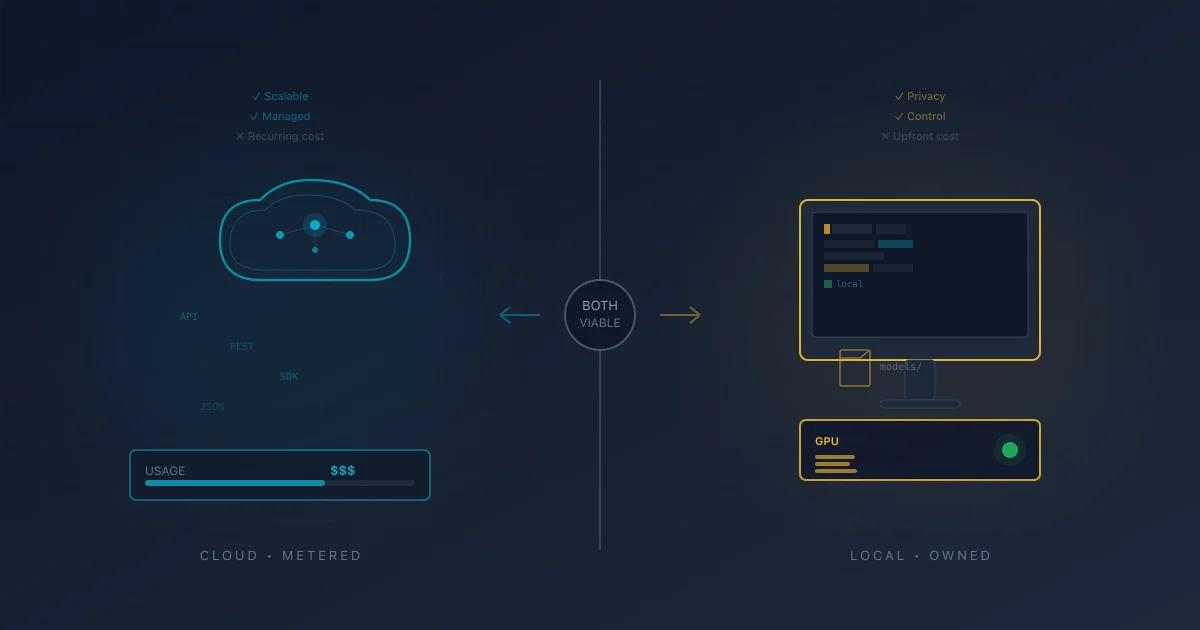
▸ The Real Tradeoffs (Cloud vs. Local)
This is where I push back against binary thinking. The question isn't "cloud or local?"—it's "what makes sense for your specific situation?"
Cloud AI Makes Sense When:
- ▹You need elastic scalability for variable workloads
- ▹You want immediate access to the latest models without hardware procurement delays
- ▹You lack AI/ML expertise in-house
- ▹You're moving fast and need minimal infrastructure overhead
- ▹Your data sovereignty requirements are manageable
Local/Self-Hosted Makes Sense When:
- ▹Data privacy is non-negotiable (GDPR, HIPAA, proprietary code)
- ▹You have consistent high-volume processing (where costs favor ownership)
- ▹Low latency matters (30-60ms local vs. 250-800ms cloud)
- ▹You need offline/edge scenarios (factory floors, remote locations)
- ▹You want full control over model customization
According to analysis from Prem AI, the smartest deployments often use a cascading architecture: route requests to a lightweight local model first, and only escalate to cloud-based frontier models when confidence is low. This approach handles 80% of requests cheaply while still accessing premium capabilities for the hard 20%.
▸ Historical Perspective: Every Infrastructure Boom Follows This Pattern
If you're feeling uncertain about where this is all heading, you're not alone. Analysts at MoffettNathanson put it bluntly: "The truth is, we're at the dawn of a new technology shift and it's really hard to know the sustainability of top line."
There are legitimate concerns. Free cash flow is turning negative for some hyperscalers. ROI remains uncertain for many use cases. As Gartner notes, AI is entering a "phase of disillusionment"—no longer visionary innovation projects but practical add-ons to existing workflows.
But here's what history teaches us: infrastructure booms always follow a pattern.
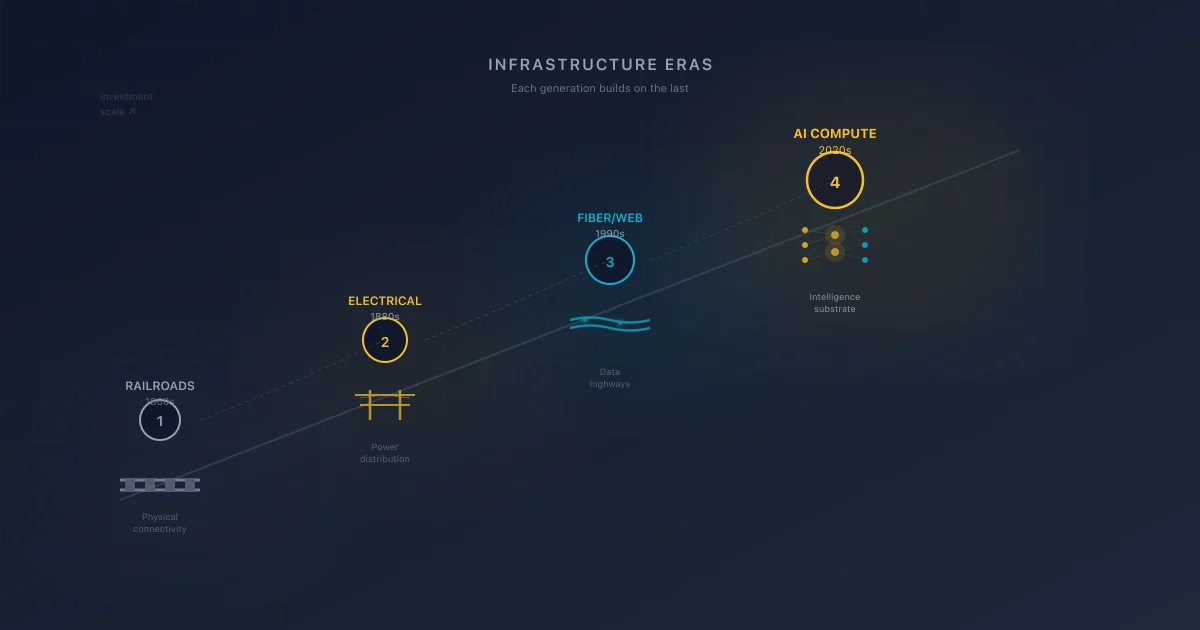
The late-1990s saw a $500 billion fiber optic overbuild that many considered wasteful speculation. Telecom companies went bankrupt. The NASDAQ crashed 78%. But as KKR's infrastructure team notes: "Bubbles always hurt some investors, but the capacity they create endures."
That "wasted" fiber became the backbone of YouTube, Netflix, cloud computing, and the modern internet economy. The companies that overbuilt went under, but small businesses and startups built the next generation of applications on the infrastructure that remained.
The same pattern played out with railroads in the 1800s, electrification in the 1920s, and PC infrastructure in the 1980s. Overenthusiastic capital deployment, shake-outs, survivors emerging stronger, and—crucially—smaller players building valuable businesses on the foundation that remained.
▸ What This Means for You
So where does this leave business owners trying to make practical decisions in 2026?
First, recognize you have real options. The infrastructure spending isn't locking you in—it's creating both powerful cloud services and catalyzing an open-source movement that gives you alternatives. The Berlin startup running Llama 3.3 on a home server to query 200 internal PDFs isn't some hacker fantasy—it's a documented deployment pattern that's working in production.
Second, match deployment to your actual needs. If you're handling sensitive customer data, a "cheap" API might be your most expensive option once you factor in compliance risk. If you're running variable workloads and have tight deadlines, cloud elasticity might be worth the premium. There's no universal right answer.
Third, start experimenting now, but think long-term. Businesses are under pressure to show ROI from AI spend, but the real transformation—like factories redesigning around electric motors in the 1920s—takes time. Early movers are learning which use cases deliver value and which are science experiments.
Finally, watch the hybrid patterns emerging. The most sophisticated deployments I'm seeing aren't pure cloud or pure local—they're thoughtful combinations. Fine-tune in the cloud with managed infrastructure, then deploy inference locally for latency-sensitive applications. Use local models for routine queries and escalate to frontier models for complex reasoning.
▸ The Long View
Will every dollar of this $650 billion generate positive returns? Almost certainly not. Will some companies overspend and face shareholder pressure? Already happening. Will the technology evolve faster than anyone expects, making some investments obsolete? Count on it.
But step back from the quarterly earnings drama and the analyst hand-wringing, and a clearer picture emerges: we're watching the construction of computational infrastructure that will power business operations for the next decade. The spending is unprecedented because the opportunity is unprecedented—AI as a horizontal layer across industries, not a point solution.
The question isn't whether Big Tech is building this infrastructure for you. The question is: How will you use what's being built?
Because just like the "wasted" fiber optic cables that now deliver Netflix to your phone, and the "excessive" cloud infrastructure that now powers half the internet, this AI buildout will become the substrate that businesses of all sizes build upon.
The infrastructure is coming regardless. The choice you have is whether to engage with it thoughtfully—understanding the tradeoffs, evaluating your options, and building AI capabilities that fit your specific needs—or to sit on the sidelines waiting for perfect clarity that will never arrive.
If you're working through these decisions and want a sounding board, I help businesses navigate AI strategy and deployment. Not selling infrastructure, just helping you think through what actually makes sense for your situation. Let's talk.
Sources & Further Reading
- ▹CNBC: Tech AI Spending Approaches $700 Billion
- ▹KKR: Beyond the Bubble - Why AI Infrastructure Will Compound
- ▹Deloitte: State of AI in the Enterprise 2026
- ▹CreateAI Agent: Self-Hosted LLMs in 2026 - The Ultimate Guide
- ▹Gartner: Worldwide AI Spending Will Total $2.5 Trillion in 2026
- ▹Business.com: 2026 Small Business AI Outlook
- ▹Prem AI: Cloud vs Self-Hosted AI - A Practical Guide
Need AI Strategy That Actually Works?
Let's cut through the noise. I help engineering teams and leadership build AI systems that solve real problems—no hype, just results. From RAG pipelines to production deployments.
Get AI insights delivered
Practical AI engineering tactics. No fluff, no spam.