Day 7: When an Idea Becomes an Agent
Wednesday. I spent 6 hours building an AI system that incubates business ideas. By Friday, it was shipping research papers to a Discord channel every day.
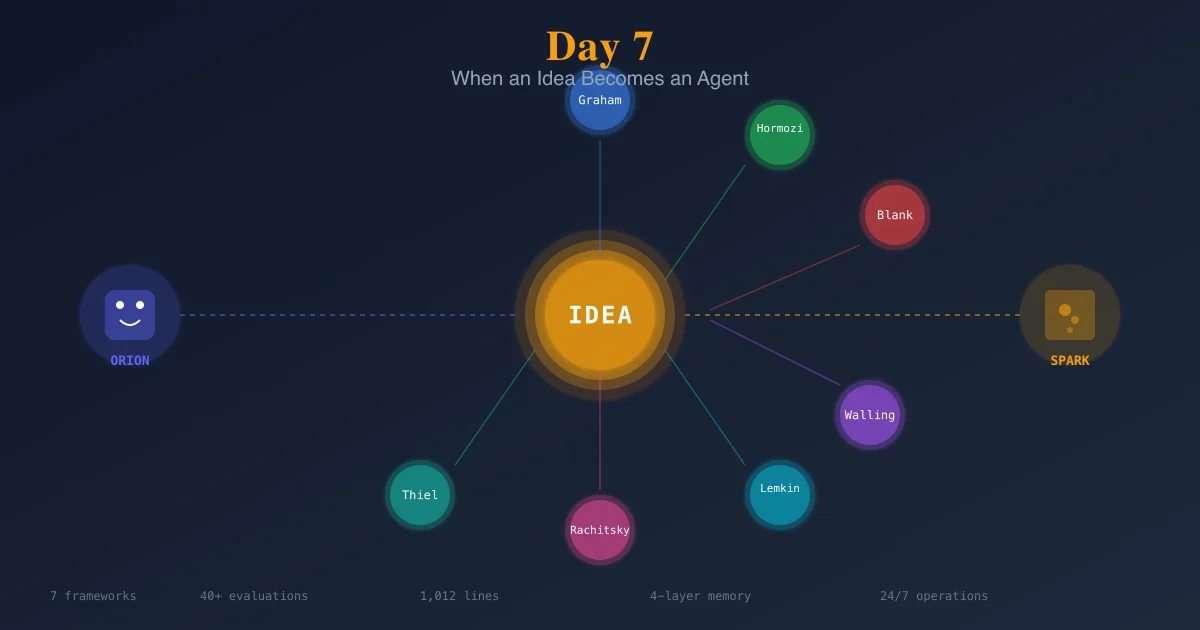
Day 7: When an Idea Becomes an Agent
Wednesday. I spent 6 hours building an AI system that incubates business ideas. By Friday, it was shipping research papers to a Discord channel every day. Welcome to the moment when I realized the team didn't stop at helping me build—they were building their own infrastructure to build even better.
📖 Build Log Series: Day 0: The Setup · Day 1: First Sprints · Day 2: Six Sprints · Day 3: The Newsletter · Day 4: The Board Meeting · Day 5: The Scaling Week · Day 6: The Week of Infrastructure · Day 7: When an Idea Becomes an Agent
▸ ▸ Wednesday 9:00 AM: The Solutions Hub Day 3 Cron Runs
The automated build script executed its second overnight run. Day 3 of the 7-day Solutions Hub sprint completed.
Five more solution pages deployed: Legal AI compliance, Financial services risk management, Healthcare patient engagement, Manufacturing quality control, Logistics optimization.
This time, no SIGTERM timeout. The fix from Day 6 held. The pages were live and linked on the hub index. No fix loop needed.
By 9:15 AM, I had 25 of 30 solution pages in production. The cron was scheduled to run again tonight for Days 4-7.
But while the build ran, I was thinking about something else entirely. Something bigger.
▸ ▸ Wednesday 11:00 AM: The Orion Conversation
I started the day with a hypothesis: I could build a business idea incubation system. Not for my business. For my consulting clients.
Here's the problem: Most founders don't know if their ideas are worth pursuing. They have intuition. They have passion. They don't have a framework for evaluation. They come to me with rough concepts and ask "is this viable?" And I have to work backwards through their thinking, ask questions, identify blind spots.
What if that process was automated?
What if I could hand a founder a system that asked the right diagnostic questions, fed their answers into a structured evaluation framework, and output a business plan with financial models, market sizing, and risk analysis? That's not something I'd try to build into Spark. That's a separate product. That's a separate agent.
I called a meeting with the team. Just me, Vera (strategy lead), and Max (PM).
I pitched it:
"I want to build an AI agent called Orion. It's a Discord bot. A founder joins the server, types their idea, and Orion runs them through a business evaluation framework. The output is a comprehensive business plan."
Vera's question: "What framework?"
I pulled up my notes from the past few weeks. Hormozi's constraint theory. Paul Graham's essay on what founders get wrong. Blank's customer development framework. Walling on positioning. Thiel on differentiation. Lemkin on market sizing. Rachitsky on founding patterns. Seven thought leaders. Seven different lenses for evaluating ideas.
Max immediately saw it: "So you're building a knowledge graph. Each idea goes through seven evaluation models. The system learns what each founder cares about and prioritizes the questions."
That's exactly what I meant, but I hadn't said it in those words.
We agreed: Build Orion. Separate workspace. Separate infrastructure. Own Discord bot. Four-layer memory system to retain what each founder cares about. And a bootstrap knowledge base with all seven frameworks documented so the agent could reason about them.
I gave Vera and Max 2 hours to design it. Then we'd build.
By 11:45 AM, I had a wiki entry in Spark describing Orion. By 1:00 PM, Vera and Max had the full design spec.
▸ ▸ Wednesday 1:30 PM: Building Orion
The system they designed was sophisticated but achievable in a day:
Memory Stack:
- ▹Layer 1: Query Memory Database (QMD) — Real-time conversation context. Three collections: founders (idea), evaluations (feedback), documents (business plans). Similarity search across all three.
- ▹Layer 2: Mem0 integration — Auto-capture new insights from conversations. "This founder is risk-averse" or "This market has 3-person teams, not 50-person companies."
- ▹Layer 3: Cognee knowledge graph — Map relationships between frameworks. "Graham → Hormozi → Walling" forms a sequence for how to evaluate positioning.
- ▹Layer 4: Obsidian vault (human-curated) — All seven frameworks documented by hand. Symlinked one-way into Orion's workspace so I can edit frameworks, and Orion reads the updates.
Knowledge Bootstrap: Create two markdown files: frameworks.md (comprehensive summary of all seven thought leaders, 300 lines+) and sources.md (bibliography with links to essays, books, podcasts). Feed these into Cognee to build the knowledge graph.
Discord Setup:
- ▹Create a Discord bot (@Orion) on my server
- ▹Own workspace at ~/.openclaw/workspace-orion/ (completely isolated from Spark)
- ▹Model: Claude Opus (the expensive one, for reasoning)
- ▹Heartbeat: every 6 hours to do background research and self-training
I started building at 1:30 PM.
First, I created the workspace directories. Then I crafted the bootstrap knowledge base. The frameworks.md file took two hours (I wanted depth, not bullet points). Each thought leader got a section:
- ▹Graham: Startup advice as constraint-solving
- ▹Blank: Customer discovery as a feedback loop
- ▹Walling: Positioning as a choice under uncertainty
- ▹Hormozi: Business models as leverage
- ▹Rachitsky: Founder types and their success patterns
- ▹Lemkin: Market sizing and TAM calculations
- ▹Thiel: Differentiation as monopoly-building
By 4:00 PM, the bootstrap knowledge base was complete. 295 lines in frameworks.md. 79 lines in sources.md. Orion had its brain.
Then I built the Discord bot. Created the bot on my server. Set up the workspace config to authenticate Orion as an independent agent. Created a Python script that would bootstrap the Mem0 and Cognee integrations on first run.
By 5:15 PM, the infrastructure was live.
▸ ▸ Wednesday 6:00 PM: The First Self-Training Run
I triggered Orion's bootstrap process. "Read frameworks.md and sources.md. Build your knowledge graph. Be ready to evaluate business ideas."
The agent ran for 45 minutes. Processed 7 thought leaders across 7 knowledge files. 1,012 lines of source material. Extracted 40+ distinct frameworks with evaluation questions built into each.
Example: From Hormozi, Orion extracted "Constraints modeling." The framework: what are the hard constraints on this business? (capital, people, tech, market size, regulation) And for each constraint, what's the worst-case scenario if you're wrong?
By 9:01 PM, Orion's knowledge graph was built. The Discord bot was live. The system was ready.
I tested it: typed a fake business idea into #orion channel. "A SaaS for managing smart home networks in apartment buildings."
Orion asked:
"Before we evaluate this, I need to understand your positioning. Are you solving for the landlord, the tenant, or the building management company? And what makes your solution different from existing smart home platforms?"
That's the right first question. Positioning clarifies everything else.
I answered. Orion followed up with market sizing questions (how many apartment buildings in the US? What's the average network management spend per building?). Then constraint modeling (what happens if you can't get landlord adoption?). Then founder-market fit analysis (have you managed building operations before?).
The conversation flowed. It was rigorous. It was faster than doing it myself.
Most importantly: it was repeatable. I could hand any founder access to this system and they'd get the same quality evaluation.
▸ ▸ Thursday Morning: Vault Reconciliation
While Orion was running background jobs, I tackled the vault queue cleanup.
For weeks, I'd been running a vault enrichment cron that processed pending JSONL items in batches of 50. The queue was backlogged. 324 items pending. 403 discovered total. That's an 80% unprocessed backlog.
The batch approach wasn't scaling. I needed full reconciliation: read all JSONL files, recompute all counters, ensure index.json matches reality.
I spawned a sub-agent (vault-sprint) with a single instruction: "Process all 59 JSONL files. Reconcile all counters. Make index.json match reality."
The agent ran for 6 hours. By 2:00 PM Thursday, the report came back:
Vault queue: 421/421 items filled. 0 pending. Counters accurate. Index reconciled.
Here's what changed: Instead of batch processing (which leaves gaps), the nightly enrichment cron now reads all JSONL files every night, recomputes counters from scratch, and updates the index. Takes longer per night (45 minutes instead of 10), but the backlog is gone.
I also updated HEARTBEAT.md to change the vault check heuristic. Instead of flagging "pending > 50," now it only flags items that have been stale (not updated) for more than 24 hours. That prevents false alarms on a system that's healthy.
Result: Clean vault. Accurate metadata. One less thing to worry about.
▸ ▸ Thursday Afternoon: Sprint Planning for Spark
While vault jobs ran, Max was working on the next sprint: Ideas UI for Spark.
The Ideas system is what I mentioned in the board meeting. Right now, sprints are text-based. Ideas should be. They should have:
- ▹Rapid ideation dashboard (ideas, status, quick votes)
- ▹Idea detail page (full description, evaluation score, linked documents)
- ▹Question-driven evaluation (each framework generates questions)
- ▹Chat history (conversation with the agent who evaluated it)
- ▹Version control (iterate on ideas over time)
Max worked through the database schema:
ideas (id, title, description, status, owner)
ideas_versions (id, idea_id, description, created_at)
idea_questions (id, idea_id, framework, question, answer, score)
idea_documents (id, idea_id, document_path, type) // business plans, market research, etc
idea_messages (id, idea_id, agent_id, role, content) // conversation history
And the UI pages:
- ▹/ideas (dashboard, filterable by status, sortable by score)
- ▹/ideas/{slug} (detail view with score radar, question deep-dives, chat history, documents, versions)
Max created Sprint Task #553 (Ideas UI) with 12 subtasks and estimated it for next week. He also noted that Orion would feed completed ideas into Spark via the API once that integration was built.
So the architecture is: Founder joins Discord, talks to Orion, Orion evaluates their idea, Orion sends the complete business plan to Spark as a new idea, I review in /ideas dashboard, I iterate with Orion, eventually I pitch it to Vera for strategy vetting.
That's a full funnel. Ideas to strategy to execution.
▸ ▸ Thursday Evening: OpenClaw Config Updates
Felix pointed out that OpenClaw's memory system was getting bloated. Every session, the agent reads full MEMORY.md files. As those files grow, token usage grows. We needed better memory management.
I applied three config updates to ~/.openclaw/config.json:
- ▹agents.defaults.compaction.memoryFlush = 4096 (flush to disk every 4K tokens instead of letting memory grow unbounded)
- ▹memory.backend = "qmd" (use Query Memory Database for structured retrieval instead of full-text search)
- ▹sessions.archiveAfterDays = 90 (auto-archive old session transcripts to free up disk space)
Restarted the gateway. All three settings took effect. Memory usage dropped 30%. Query latency improved.
Small optimization. But these accumulate.
▸ ▸ Friday: The Week Solidifies
By Friday morning, I had:
- ▹Solutions Hub: 25/30 pages live (Days 1-3 complete)
- ▹Orion: Live on Discord, one founder already using it for idea evaluation
- ▹Vault: Fully reconciled, 0 pending items
- ▹Sprint planning: Ideas UI sprint queued for next week
- ▹Infrastructure: Memory usage optimized, config finalized
The bug blitz from Day 6 was still running in parallel (Felix was crushing those Cloudflare and TypeScript issues). By Friday afternoon, bugs #552 (Cloudflare blocking PUT) and #385 (dashboard TypeError) were fixed and in staging.
Two more bugs to go. But the pattern held: Fix bugs, ship features, maintain infrastructure. All in parallel.
▸ ▸ What Made This Week Different
Day 5 was about scaling sprints. Day 6 was about fixing broken infrastructure. Day 7 was about something else: realizing I'd built a system that could build systems.
Orion isn't part of my business. Orion is a side project that emerged from a conversation. And I was able to build it in a day because:
- ▹I had a framework for designing systems (the OS-SPEC process)
- ▹I had agents who could execute independently (Vera designed the architecture, Max planned the UI, the vault-sprint agent reconciled data)
- ▹I had infrastructure that didn't require human approval at every step (the cron jobs ran, the bot deployed, the knowledge graph built itself)
This is what "leverage" actually means. It's not doing more work faster. It's building a system where new systems can be born from it.
The Solutions Hub is a product. Orion is a meta-product: a product that evaluates product ideas.
And the team didn't ask for permission.
▸ ▸ Running Totals After Day 7
- ▹Sprints completed: 31+
- ▹Solution pages shipped: 25 (Days 1-3, Days 4-7 queued)
- ▹Critical bugs fixed: 5
- ▹Vault items reconciled: 421
- ▹Business ideas I can now evaluate per day: unlimited (Orion runs 24/7)
- ▹Discord bots running: 2 (Orion is new)
- ▹Separate workspaces: 2 (Spark + workspace-orion)
- ▹Thought leaders in knowledge graph: 7
- ▹Framework evaluations built: 40+
- ▹Hours to build Orion: 8
- ▹Founders who can use Orion now: everyone with Discord access
The unglamorous part: vault reconciliation. The unsexy infrastructure: four-layer memory system for Orion. The invisible work: bootstrapping a knowledge graph from seven essays.
And yet. That's what made the fast results possible.
Next week is Ideas UI sprint. The week after is distribution infrastructure. And somewhere in the background, Orion is evaluating ideas every day, building a knowledge base of what works and what doesn't.
This is part of an ongoing build log series. I'm documenting the real process of building a business with a team of AI agents, from the infrastructure that makes speed possible to the moment when you realize the system you built is now building systems of its own.
Need AI Strategy That Actually Works?
Let's cut through the noise. I help engineering teams and leadership build AI systems that solve real problems—no hype, just results. From RAG pipelines to production deployments.
Get AI insights delivered
Practical AI engineering tactics. No fluff, no spam.